- Receive the latest news and offers on this course.
Coming soon!
Procedural Worlds in Godot
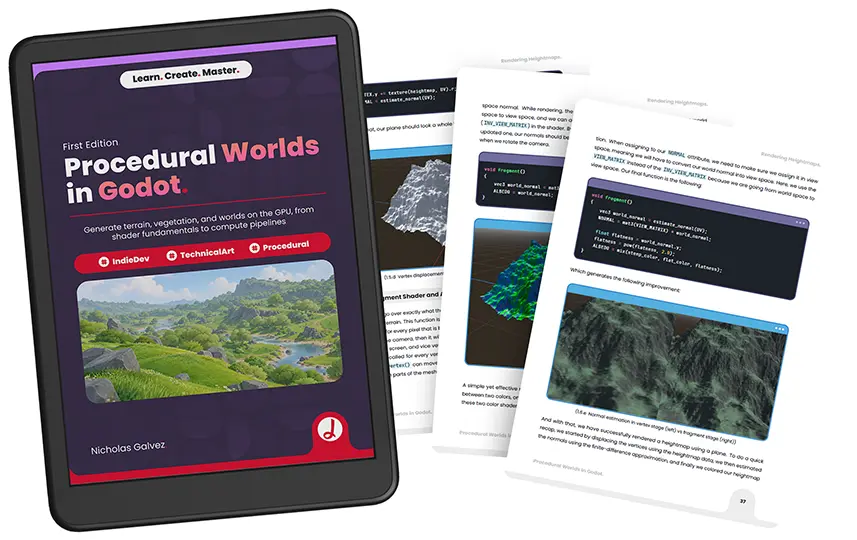
Generate terrain, vegetation, and worlds on the GPU, from shader fundamentals to compute pipelines.
Coming Soon
Nicholas Galvez
First Edition 2026
~250 pages
eBook
Who is this for?
Godot developers
Generate large, varied terrains without modeling them by hand.
Technical artists
Add procedural generation and GPU techniques to your toolkit.
Shader learners
Get into compute shaders through a practical, visual project.
Open-world creators
Build scalable environments for survival, exploration, or open-world games.
Procedural Worlds in Godot takes you from a single grayscale image to a full, living environment. You'll start with heightmaps and learn how to turn them into 3D terrain using vertex and fragment shaders, with proper normals and color. From there, you'll implement two classic terrain algorithms, Fractal Brownian Motion and Diamond-Square, and understand exactly how parameters like octaves, lacunarity, and gain shape the result.
Then the book moves to the GPU. You'll learn what compute shaders are, how buffers and parameters work, and how to use them in Godot to run a hydraulic erosion simulation that carves realistic valleys and ridges into your terrain. To finish, you'll populate the world with grass and trees using GPU instancing, and add animated water built from a sum of sinusoids.
By the end, you'll have a complete procedural environment pipeline running in real time, and the knowledge to adapt it to your own projects.
Content Included.
Note: The chapters, descriptions, and main topics listed below are provisional and may be added to, merged, or otherwise modified as the video course is being developed. We’ll update this list every time a new chapter is released.
Table of Contents.
1. Introduction to heightmaps
(Coming Soon)
- What is a heightmap?
- UV coordinates.
- Limitations.
2. Rendering heightmaps
(Coming Soon)
- 3D meshes and vertex shaders.
- Normals and fragment shaders.
- Adding colour.
3. The Fractal Brownian Motion algorithm
(Coming Soon)
- Perlin noise and pseudo-randomness
- Octaves, lacunarity, and gain
- Improvements: value type and gradient masking
4. Introduction to compute shaders
(Coming Soon)
- What is a compute shader?
- Buffers and parameters.
- Compute shaders in Godot.
5. The Diamond-Square algorithm
(Coming Soon)
- Midpoint displacement and steps.
- Square step sampling types.
- Normalisation.
6. Erosion simulation with a compute shader
(Coming Soon)
- What is hydraulic erosion?
- Simulating particles.
7. Adding foliage
(Coming Soon)
- What is GPU instancing?
- Adding grass.
- Adding trees.
8. Adding water
(Coming Soon)
- Sum of sinusoids.
- Water shader.
Featured eBook Bundle.
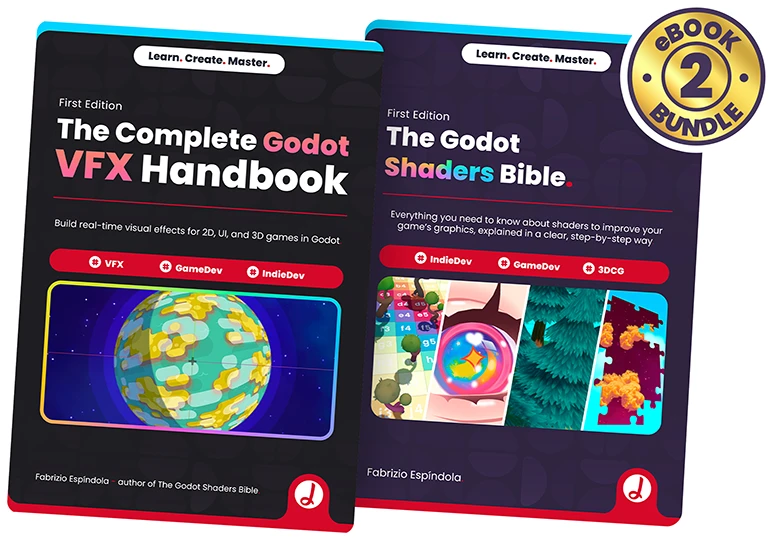
The Godot All About VFX Bundle
Get +600 pages of practical content covering shaders and 2D, UI, and 3D VFX in Godot, all bundled at a special price!
$59.98
$43.19
Save $16.79 - 27% off
About the author.
Frequently Asked Questions.
What do the books include?
Our books are crafted to provide a deep understanding of each topic with step-by-step explanations, real-world examples, and practical exercises. Each book includes detailed chapters, illustrations, and code samples designed to help you build skills as you read. All of our eBooks are downloadable in PDF format, making it easy to access them offline anytime. Many books also come with supplementary downloadable assets or files to support your learning.
Do the courses/eBooks include updates?
Our books, which are published chapter by chapter, are also updated regularly until they are considered complete. This approach allows you to benefit from the latest information and improvements as you progress through the material. Once a book is finalized, it remains available in its completed form, and you'll have access to any free updates within the same edition that may include fixes and small improvements.
Can I download the eBooks?
Our eBooks are fully downloadable in PDF format, allowing you to access them offline anytime.
What do the Hardcover editions include?
Some of our books are offered in a special Hardcover edition through our partner Lulu. If you purchase one, you may also request the project files. If you get the Hardcover edition and don't have an account on Jettelly, we can also create an account for you automatically. Please reach us on [email protected] to get started.
Do you offer certificates upon course completion?
No, we currently do not offer certificates upon course completion. Our focus is on providing high-quality content and practical skills that you can immediately apply to your projects and portfolio.
How long will I have access to the eBooks/Courses after purchase?
You'll have lifetime access to any course you purchase, as long as Jettelly Inc. exists. This allows you to revisit the content anytime and learn at your own pace, without any time restrictions. If you have any questions regarding previous purchases, feel free to email us at [email protected]
Can I get a refund if I'm not satisfied with my purchase?
Unfortunately, due to the nature of our downloadable eBooks, we do not offer refunds. For Hardcover editions, we offer exchanges in case of print quality issues through Lulu. Regardless, if you have any questions or concerns, please reach out to our support team at [email protected], and we'll be happy to assist you.
What happens if I buy a product in development and it's never finished?
Jettelly will issue a refund minus taxes and admin fees.
Will I receive access to future new editions?
New editions of a book or course are considered separate products, and we may offer a discount to owners of the previous edition, at the discretion of the author and publisher.

Other courses that might interest you.
-
 Fabrizio Espíndola, Harrison Ferrone, Joseph Hocking, Nicholas LeverBundle$72.72 54% OFF
 -
-
-
-
-