
A Free Modular House & Pine Forest Environment for Unreal Engine 5
by Vicente C.
Published |
1,349
Working with environment assets in Unreal Engine can seem simple at first. Marketplaces are full of assets, in this case trees and buildings, that look great in screenshots or cinematic scenes, but things tend to fall apart once they’re used across larger environments in an actual game.
Laglanz ran into this while building a prototype for their own project. Despite the variety of available packs, none of them behaved the way he needed in practice, especially when placed across large maps or used under real gameplay conditions. That led him to start building his own trees and modular houses from scratch.
This eventually led to the release of Modular Rural House & Pine Forest Environment, a free asset pack for Unreal. Here’s a closer look at how it was built.
Trees Built for Large-Scale Environments
One of the main issues with existing vegetation packs comes from how trees are authored. Many assets use multiple materials per tree, each with unique textures and strong visual variation. While this can look impressive in dense renders, it creates problems in open environments.
When trees are spread out across a large map, their uniqueness becomes more noticeable. Instead of blending into a cohesive forest, each tree starts to stand out individually. At the same time, the use of multiple materials and textures increases memory usage significantly.
To address this, the trees in this pack were built using a much more constrained setup:
- Each tree uses only two materials
- These materials are shared across all trees
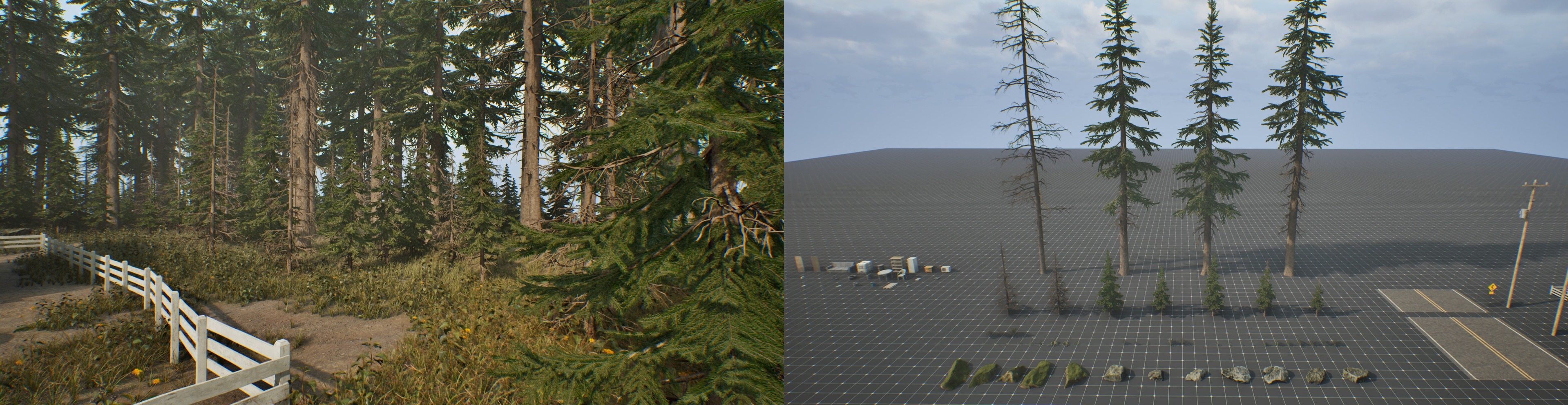
An important side effect of this approach is spacing. Because the trees are more uniform, they can be placed farther apart without drawing attention, so the forest still looks natural even with lower density.
Modular Houses Designed for Gameplay Constraints
Similar issues appeared with building assets. Most modular house packs are built close to real-world proportions. In practice, this causes several problems in Unreal Engine, especially when using Lumen and standard character controllers.
Two key constraints drove the design here:
- Wall thickness: Lumen requires walls to be at least ~20 units thick to behave correctly
- Door width: Player characters need doorways around 125 units wide or more to move comfortably
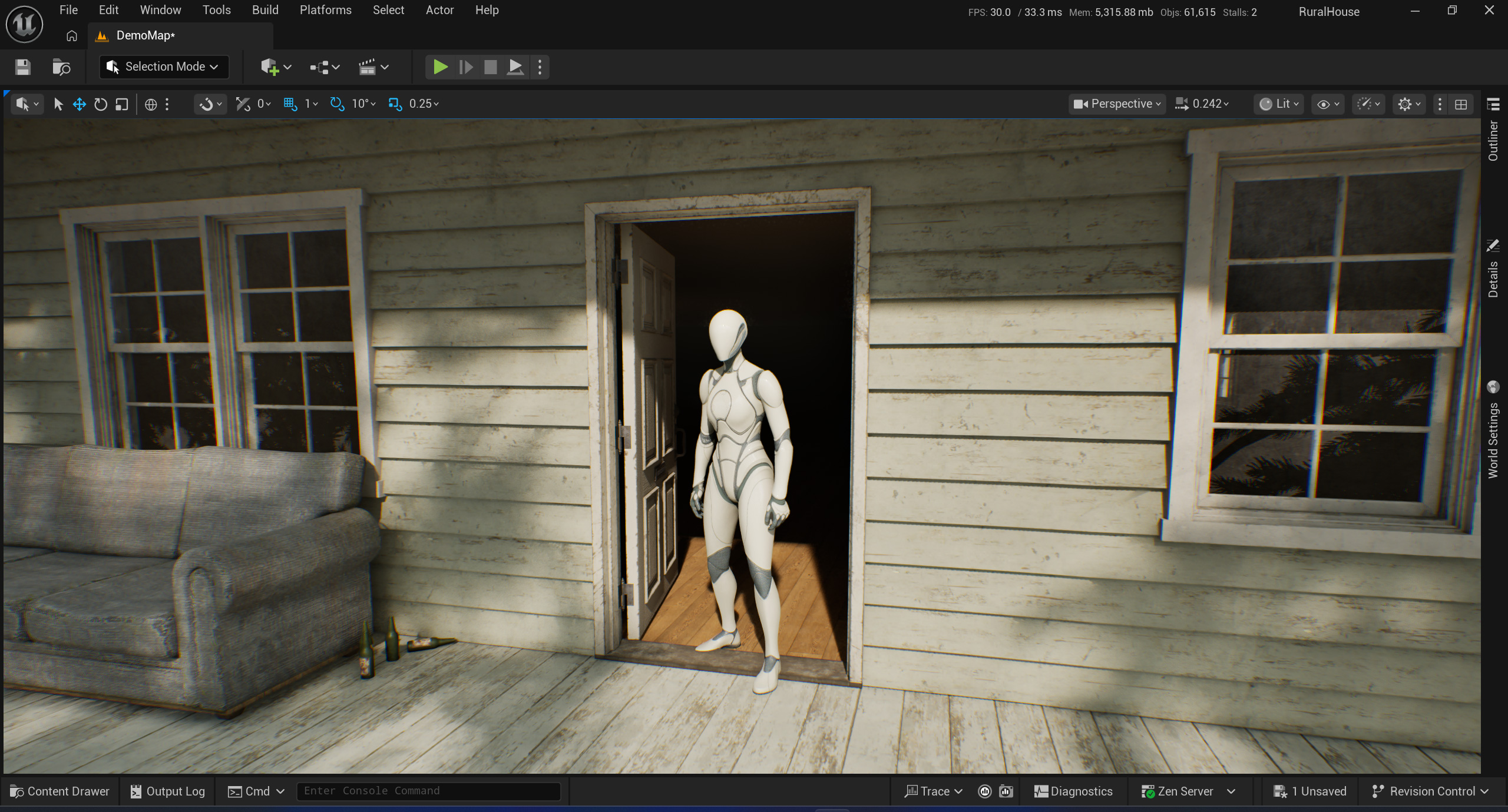
Existing packs often fail on both points. Walls are too thin for proper lighting, and doors are too narrow for gameplay. Scaling the assets is not a reliable fix, since it introduces new issues like oversized doorframes and poorly positioned windows.
The solution was to build a modular set from scratch with:
- consistent 20-unit wall thickness
- game-friendly door dimensions
- a neutral, generic visual style
The visual style is an important detail. Just like trees, buildings often act as background elements. A strong visual identity can make repetition obvious when many instances are placed in a level. Keeping the design more generic helps it scale better across larger environments.
Reducing Texture Usage with Shader-Based Detail
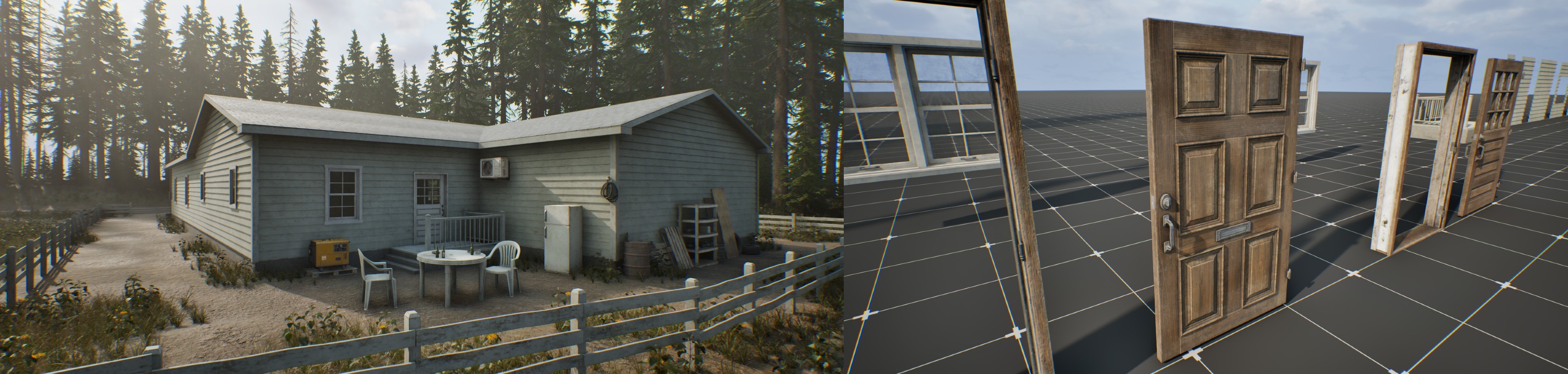
Another issue comes from how textures are handled. To avoid using multiple texture sets, the pack uses shared materials with a custom shader. Instead of baking wear and variation into separate textures, the shader detects object edges and applies a chipped paint effect procedurally.
This has a few practical implications:
- No need for additional mask textures
- All painted wood elements share the same texture set
- Variation is controlled through material parameters, not new assets
Changing those parameters adjusts how strong the worn effect looks across different objects.
Procedural Forest Distribution with PCG
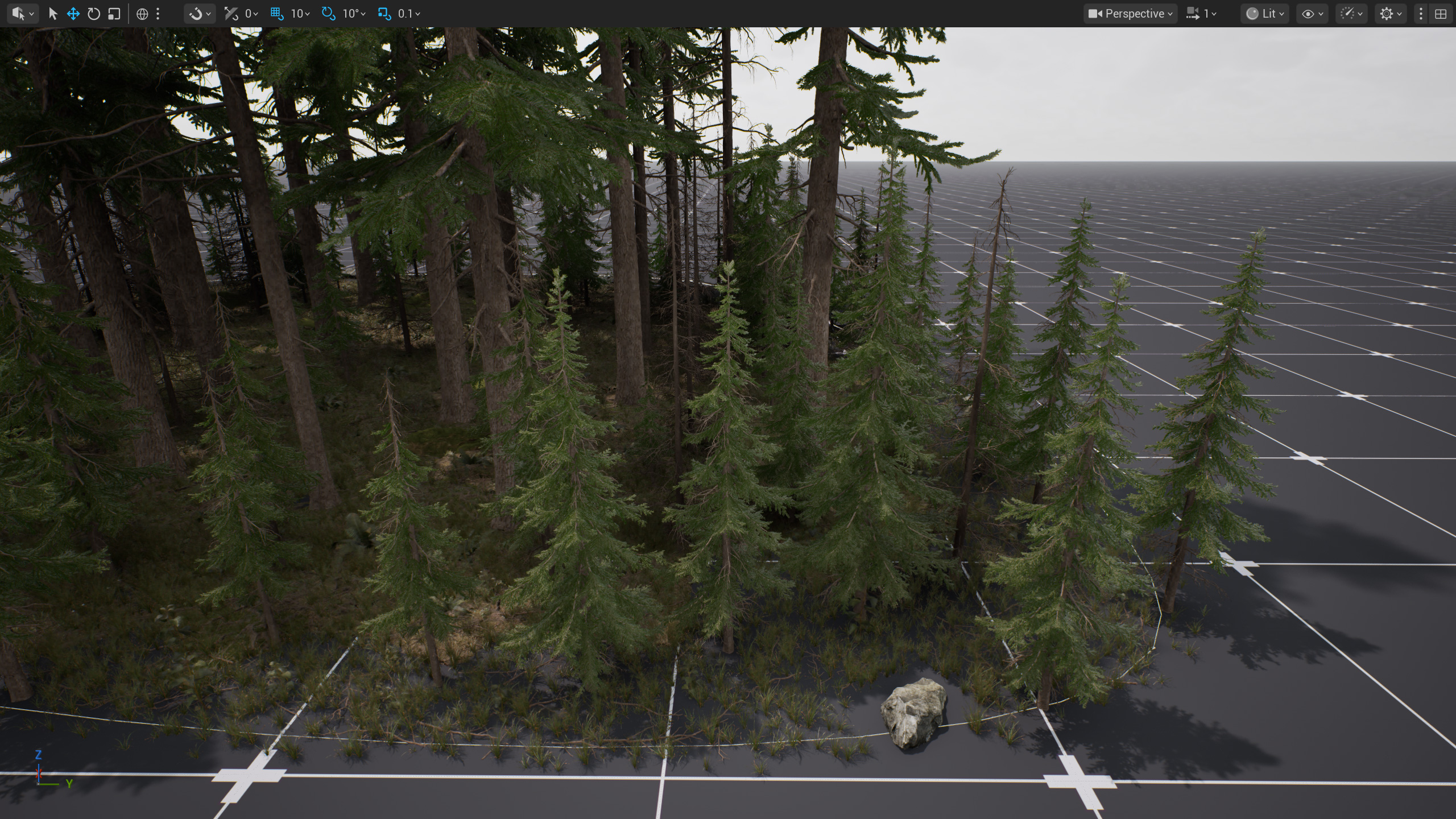
Asset distribution plays a key role in how the forest is set up.. The pack includes a PCG (Procedural Content Generation) graph that controls vegetation placement based on location within the forest.
The distribution follows a simple structure:
- Near the edges: smaller trees and grass dominate
- Deeper areas: taller trees become more common, and grass transitions into ferns
The foliage also uses Nanite Voxelize Foliage (UE 5.7), which helps handle dense vegetation more efficiently.
Sharing the Pack and Ongoing Work
The pack was originally created for internal use during development. Releasing it publicly came from not wanting that work to go unused.
Laglanz comes from a programming background, with no prior experience creating this kind of content. Building the pack involved learning tools like SpeedTree and putting together systems that matched specific needs that weren’t covered by existing assets.
Sharing it is partly about giving that work a second use, and partly about making things easier for other developers running into the same problems.
Laglanz also released a free Unreal Engine plugin for repacking texture channels directly inside the editor
Laglanz also released a free Unreal Engine plugin for repacking texture channels directly inside the editor
They are also working on another plugin for AI behavior as an alternative to Behavior Trees, aimed at simplifying how NPC behaviors are set up.
Both tools follow the same approach as the asset pack: practical solutions developed during production, then shared publicly. You can explore more of Laglanz’s work and follow tool updates here:
- Laglanz’s Patreon: https://patreon.com/NowhereHighway
- Laglanz’s YouTube: https://www.youtube.com/@laglanz
- Free Rural House & Pine Forest asset pack: https://www.fab.com/listings/a081748c-6a49-4ba4-9008-9b10fadf8f73
Interested in learning more?
If you’re interested in the technical side of Unity? The Unity Dev Bundle brings together six books covering shaders, math, procedural shapes, editor tools, and character customization.
This is for developers and technical artists who want to build a stronger foundation and work with more advanced graphics and systems in their projects.
Getting into the technical side in Unity? 👀 Our six-book bundle covering shaders, math, animation, and tools is back for a limited time! ✨
— Jettelly Inc. (@jettelly) April 2, 2026
Check it out: https://t.co/hXakjJfm72#unity3d #gamedev #indiedev pic.twitter.com/zGQYT5da5M
Jettelly wishes you success in your professional career!
Did you find an error? No worries!
Write to us at [email protected], and we'll fix it!

Level up your Unity skills with our new six-books bundle!
We invite you to explore "The Unity Dev Bundle", a comprehensive bundle on the concepts and fundamentals seen in this post.
Other posts that might interest you.
-
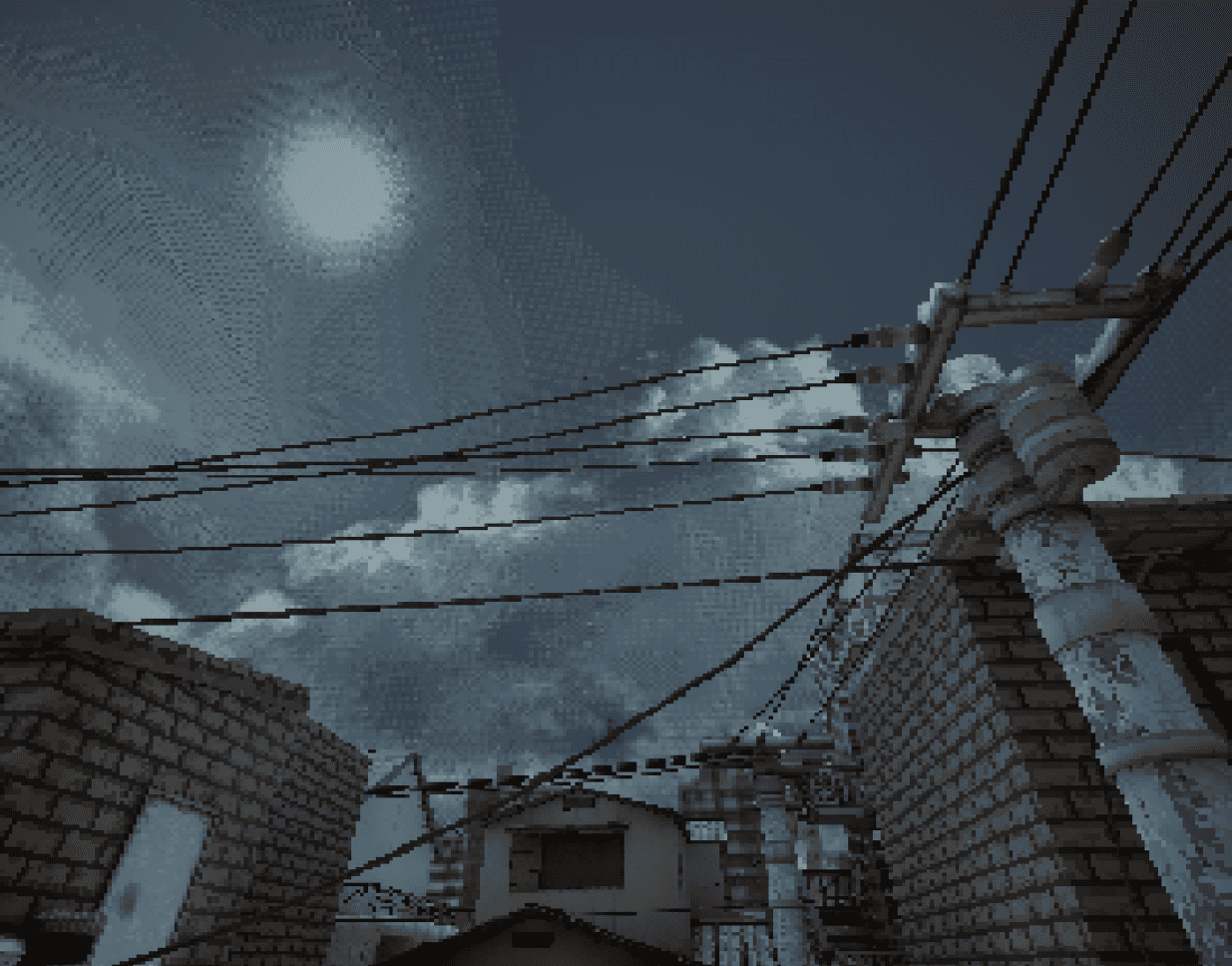 DreamIntoleance shared the visual approach behind Invisum Piscium, a PSX-inspired project that mixes pixel-textured 3D models with UE5 lighting.
 -
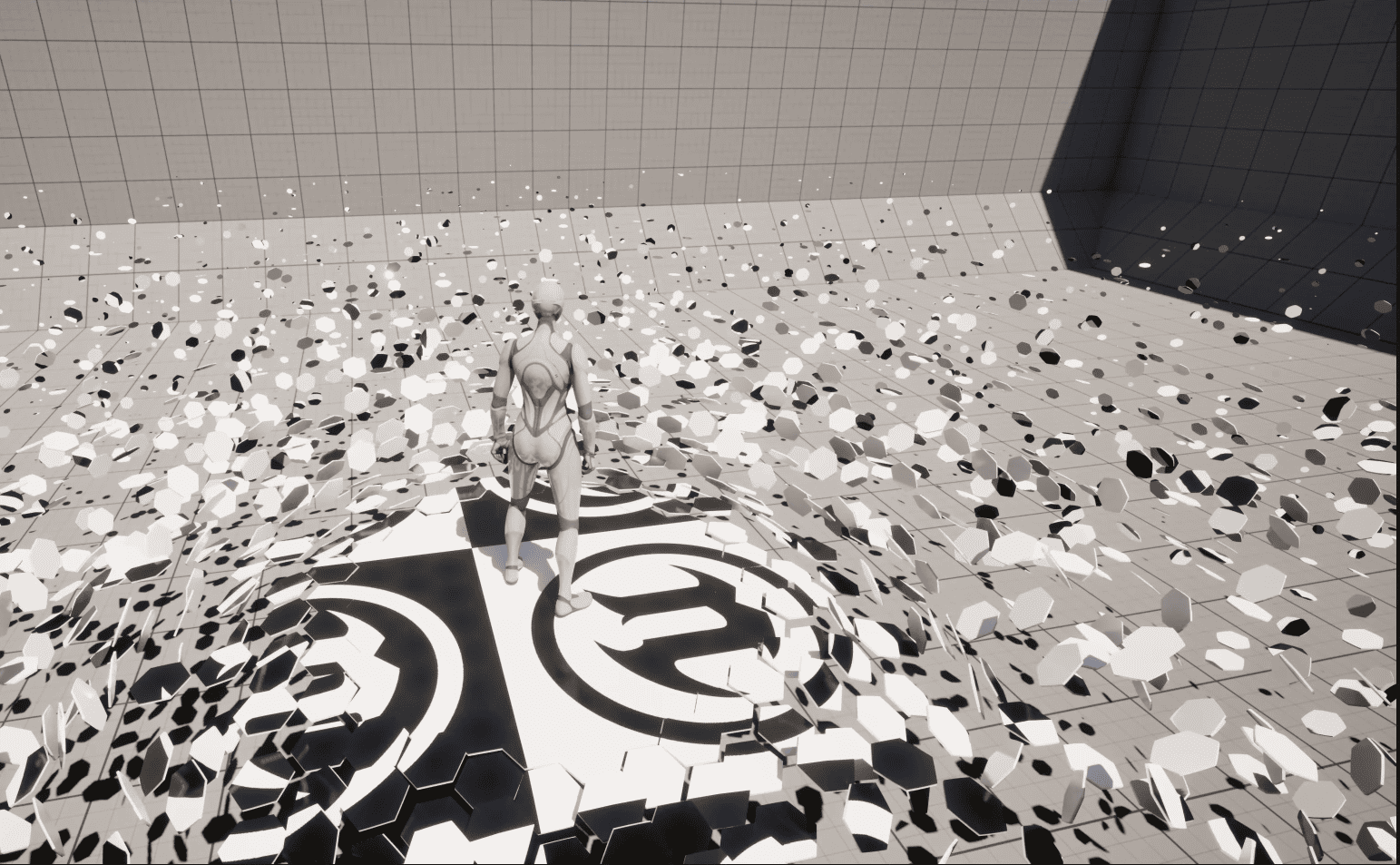 Oleksandr M. walked us through how his GPU-driven vertex shader handles thousands of real-time reactions in Unreal Engine.
 -
.png) Adrian Caminero Navarro shared a water shader study in Unreal Engine, exploring shoreline interaction, contact foam, and refraction using Single Layer Water.
Adrian Caminero Navarro shared a water shader study in Unreal Engine, exploring shoreline interaction, contact foam, and refraction using Single Layer Water.
